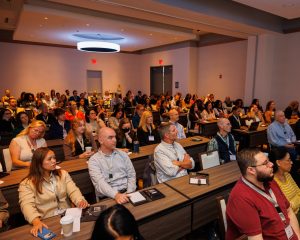
This past September, PMI Boston hosted our annual chapter-wide conference, the Project Leadership Summit. In case you missed it, more than 250 professionals gathered in Boston’s Seaport district with one shared goal: to learn from one another. Sessions centered on the topics shaping project work today, from artificial intelligence to leadership, and speakers from across the country came to share their ideas and spark deep discussions about building stronger leaders. Between sessions, we sat down with three speakers, one from each track, to talk about their careers, their talks, and what they hope people take home. Here’s what stood out!
Offiong Bassey on Finding Rhythm in the Age of Artificial Intelligence
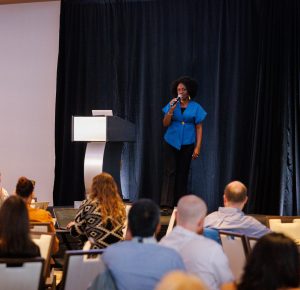
Offiong Bassey’s AI track session brought a creative approach to a very practical question: how do project teams stay in step when AI is moving the work faster than ever? Offiong, founder and principal of Basante Strategic Advisory, built the talk around three pillars drawn from the language of music, a deep passion of hers. The pillars take us through efficient use of AI while maintaining the human aspect of leadership and collaboration.
Find the Key (Build Shared Meaning): Establish unified definitions and clear criteria for success across all teams before leveraging AI, ensuring everyone interprets output and data consistently.
Set the Beat (Establish Cadence & Governance): Align governance structures and decision-making schedules with the accelerated tempo of AI deployment, setting clear guardrails for accountability and cross-functional reviews.
Make it Move (Advance the Progression): Move beyond analysis paralysis and continuous iteration by establishing clear ownership to convert AI-generated insights into actionable execution.
During the Q&A, an attendee asked what to do when a team has no shared key at all. Offiong’s answer was direct: this is a leadership and organizational challenge first, and it takes courage to address. As Offiong put it:
“We, the creative, the strategic, the fully human, are not there to manage the machine.”
Eric Foss on Turning Good Ideas into Business Value
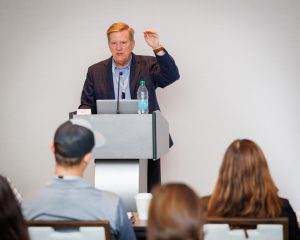
Eric Foss’ path to the stage was anything but linear. He spent a little over a decade in the military, where he learned project and program management as a collateral duty. He then worked at Electronic Data Systems (EDS), where he saw a more structured approach to PMI practices, and he has been a management consultant since. Today he leads a consulting business, a project management training arm, and a project-management-as-a-service offering.
Eric’s innovation talk tackled a gap many organizations know well: plenty of bright ideas, but little clarity about which ones are worth the investment. He framed ideation as the front end of innovation, connected to a decision process and then to delivery. The structure he described includes decision gates, shaping an idea into something tangible, prioritizing it within a strategic portfolio, and measuring whether the benefits were actually realized.
One idea from his talk stayed with us:
“Projects don’t just happen because of mechanics; they happen because of people.”
Eric also reminded the room that “to make the hard decisions, you need to have the hard discussions,” and that facilitating those discussions well is what keeps governance from feeling bureaucratic.
Lisa DiTuilio on Leading People Through Change
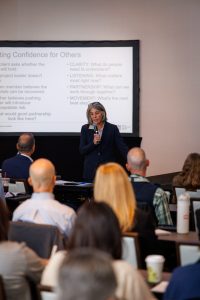
Lisa DiTuilio’s leadership session opened the morning with a focus on people. She has spent decades in project management and PMO roles, most of them in healthcare, and she said those skills transfer easily to other sectors. Her approach is to simplify practices rather than rely on heavy processes or large toolkits.
Her talk explored how rapid change affects people both at work and at home, and how leaders can help their teams grow into the next generation of leaders. She cautioned that the field can become too process-oriented and lose sight of the human side. Her definition of leadership was refreshingly simple: “never telling anyone what to do.”
For newer professionals entering the field during uncertain times, her advice was to shift the question. Instead of focusing on what they cannot do, ask what happened, what they learned, and what they know now that they did not know yesterday.
“Focus on how we can learn, how we can get better.”
Lisa also encouraged PMI and its chapters to stay connected to the realities their members face, and to be bold enough to test changes, even when some don’t last.
Bringing It All Together
Each speaker approached their track from a different angle, but all discussions shared a key idea: systems matter, and people make them work. Whether the topic was AI, innovation, or leadership, the message was that the best structure still depends on people who listen, decide, and guide their teams.
Thank you to Offiong, Eric, and Lisa for sharing their time and their honest reflections with us. We hope you left with new ideas, new connections, and a fresh way to think about the people behind every project.